Those of us who believed that in a nation of laws the prohibition of torture may claim absolute validity find themselves disabused since the beginning of the new mil-lennium. The current challenges by terrorism have led to theoretical approaches to relativize the prohibition of torture as it is formulated unequivocally in Article 3 of the European Convention of Human Rights and in the United Nations Convention against Torture and Other Cruel, Inhuman or Degrading Treatment or Punishment. The following suggestive question is invoked by the relativists: May a captive terrorist be tortured if this is the only way to compel testimonies which are required to avoid harm to or the death of other humans?
And what about capital punishment? It is well known that after dramatic murder cases, hostage-takings, and terrorist attacks, the voice of the people calls for the execution of the delinquents. It is true that the number of countries carrying out executions is decreasing1. But among those nations where executions are carried out, we also find free and democratic constitutional states ruled by law, such as the United States and Japan.
It was in the eighteenth century that the United States became the paragon of freedom by proclaiming the Declaration of Independence in 1776, and it was in that period when torture and capital punishment became for the first time the subject matter of philosophical reflec-tion. The protagonists of this debate were Pietro Verri and Cesare Beccaria.
As early as 1763, Pietro Verri made fundamental arguments against torture in his Panegyric Oration on Milanese Jurisprudence 2, read in the Accademia dei Pugni in Milan, as well as in his satirical almanacs The Ache of Spleen3 and The Great Zoroaster4 of 1764. In the same year, Beccaria’s On Crimes and Punishments appeared anonymously in Livorno, including a chapter On Torture5.
Between 1776 and 1777, Pietro Verri wrote his Observations on Torture, but he did not publish it since his father, Gabriele Verri, who was at that time President of the Milanese Senate, had prepared a report against the abolition of torture in Milan. So, Pietro’s book did not appear before 18046. His Observations is an impres-sive polemic revealing the inhumanity and absurdity of torture. A great part of Verri’s book is dedicated to the history and documentation of the so-called Plague Plot of 16307. The trial associated with that plot in Milan in 1630 supplies the historical and theoretical background for Verri’s Observations on Torture.
The main defendants of the trial were accused of having disseminated the plague deliberately by slathering an infected ointment on a mural. The Public Health Inspector himself, Guglielmo Piazza, was observed passing close to a mural and then touching a laurel plant. In the subsequent criminal trial, Piazza confessed – after being tortured – not only to having committed the crime of mural slathering, but also that he had received the pestilent ointment from the barber Giangiacomo Mora, who confirmed – under harsh inquiry and torture – that he had confected the toxic substance by mixing the excrements, spittle, and bath water of deceased plague sufferers and had handed it over to Inspector Piazza. After these confessions, the investiga-tions were extended to further suspects, and several death sentences were carried out.
What reasons do Verri in his Observations on Torture and Beccaria in his On Crimes and Punishments give against torture? Crucial for their argumentation is, first of all, a precise definition of torture. This is all the more important since, to this day, the term is equivocal in most European languages; it signifies both a method of questioning a suspect or an accused and a form of cruel punishment of a sentenced delinquent. Taking into account this ambiguity, Verri understands the expression ‘torture’ to mean ‘not a punishment which is carried out against a defendant by judicial decision, but rather the alleged investigation of truth by inflicting pains and cruelties’8. For this very rea-son, I suggest speaking, as I do in the title of this paper, about ‘interrogational torture’. The distinction between investigation and punishment is essential for Verri’s and Beccaria’s arguments, which show that torture is not and can never be an effective method of investigation. Since the purpose of the criminal trial consists of discovering the truth, the crucial question is, as Verri claims, ‘whether torture can be a tool for the investigation of truth’9. If it were indeed such a tool, we would have to compare – as the arguments for torturing terrorists suggest – and balance the cruelty of torture against its efficiency in discovering the truth. Thus, it has to be proved or disproved that torture is an effective means of discovering the truth. On this issue Verri and Beccaria invoke the following arguments:
Firstly, according to the definitional distinction between investigation and punishment, the principle of presumption of innocence forbids tormenting a human whose guilt is not established. When the facts of the case are proved, torture is unnecessary. But if there are doubts, interrogational torturing could mean tormenting an innocent person. This is all the more intolerable since that cruel injustice would be committed by the authority of the state whose duty is to protect the innocent10.
Secondly, torture is not an effective means for the investigation of truth, and it leads to injustice. The phys-ically and psychically strong delinquent will endure all torments, whereas the sensitive innocent will confess falsely. Robust criminals will be saved from punishment, while weak falsely accused humans are penalized without any reason11.
Thirdly, under the influence of pain, the tortured has no interest in truth, but only an interest that the pain stops immediately. Therefore, pain can by no means be a ‘touch-stone of truth’12.
Fourthly, if it is evident that torture is no method for the investigation of truth, it is also evident that it is incapable of getting onto the track of accomplices. And a human, even if he is a delinquent, may not be tortured for the crimes of others13.
Fifthly, interrogational torture contradicts the inalienable natural right to self-defense. Interrogational torture appeals to self-accusation, which is absurd and inconsistent, for one and the same person cannot possi-bly be at once accuser and accused. When the civil code does not admit accusations by relatives and spouses and when a lawyer cannot be compelled to betray his client, it is absolutely absurd for a person to be an accuser against himself14.
The supporters of capital punishment have no less a philosopher than Immanuel Kant on their side. He deduced the legitimacy of the death penalty from the ‘principle of equality’.
But what kind and what amount of punishment is it that public justice makes its principle and measure? None other than the principle of equality […]. Accordingly, whatever undeserved evil you inflict upon another within the people, that you inflict upon yourself. If you insult him, you insult yourself; if you steal from him, you steal from yourself; if you strike him, you strike yourself; if you kill him, you kill yourself. But only the law of retribution (ius talionis) […] can specify definitely the quality and the quantity of punishment […]. If, however, he has committed murder, he must die. Here, there is no substitute that will satisfy justice. There is no similarity between life, however wretched it may be, and death, hence no likeness between the crime and the retribution, unless death is judicially carried out upon the wrongdoer, although it must still be freed from any mistreatment that could make the humanity in the person suffering it into something abominable15.
‘If, however, he has committed murder, he must die.’ This is Kant’s rigorous conclusion. For him the murderer’s death is the only means to do justice to him and to atone for his crime. With this argument, Kant explicitly opposes Beccaria, who had published On Crimes and Punishments in 1764, and at the time was renowned throughout Europe as a decided adversary of capital punishment.
In the sixth edition of Beccaria’s book, we find an alle-gorical copperplate engraved by Giovanni Lapi according to the ideas that Beccaria himself gave to the artist. On the left, we see Justitia on her throne, and on the right, the exe-cutioner who just has decapitated two delinquents. In his right hand, he holds his probably still bloodstained sword, and in his left, the two detached heads. He offers Justitia the heads, but she turns away in horror. Instead, her view is directed to the bottom left. There lie the scales of justice, which are extremely harmed by capital punishment. Traditionally, Justitia keeps the scales in one hand and the sword in the other. But Beccaria’s Justitia rejects the sword and directs her view to the other objects lying at her feet – objects referring to the alternatives to capital punishment: a yoke, chains, a shovel, and hammer stand for the penal servitude which Beccaria thinks should replace capital punishment.
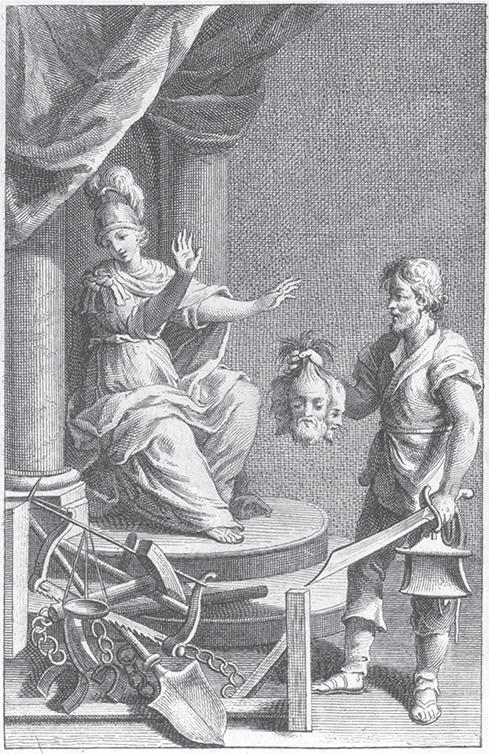
Figure. Copperplate by Giovanni Lapi, frontispiece of Beccaria’s Dei delitti e delle pene, edizione sesta, Harlem, 1766.
The first reaction to Beccaria’s anonymous book came from Venice. At the beginning of 1765, Notes and Observations on the Book entitled On Crimes and Punishment was published also anonymously. The author of this book was Father Ferdinando Facchinei. He criticized the ‘false and absurd principles’ that underlie the anonymous book, namely the principles of liberty, of the natural equality of humans, and of the foundation of society, state, and law in ‘free contracts’ of those free and equal humans – and therefore, Facchinei labeled the anonymous author ‘the Italian Rousseau’16.
When Father Facchinei targets, first of all, the cen-terpiece of Beccaria’s book, the rejection of capital punishment17, he conceals – or he perhaps simply does not know – that Rousseau was, unlike Beccaria, a decided proponent of capital punishment and that it was just Rousseau’s consequential contractualism which provided the basis for his arguments. Beccaria revealed a fatal weak spot in Rousseau’s theory of the social contract. Rousseau’s argument in Chapter ‘On the Right of Life and Death’18 is quite suggestive. He does not deny the ‘jusnaturalistic’ concept of the inviolability of human life as it was, for instance, maintained by Locke, who assumed that man ‘has not Liberty to destroy himself ’19. On the contrary, Rousseau begins his apology for capital punishment with an overt reference to Locke: ‘It may be asked how individuals, having no right to dispose of their own lives, can transmit to the sovereign power a right which they do not possess?’20 But Rousseau considers the question ‘improperly stated’ and relativizes Locke’s assumption by conceding to each human the ‘right to risk his life for the preservation of it’, like a person who throws ‘himself from a window to avoid the flames of a burning house’21.
Against the background of this scenario, the individual’s sacrifice of the right to life appears no more than the risk he takes for the sake of his own security. When the individual subscribes to the social contract, he assigns the right of life to the state, in order to preserve his life. From Rousseau’s perspective, life is no longer merely a ‘boon of Nature’ but a ‘conditional gift from the state’22. Rousseau’s radical and systematic contractualism entails a negation of any natural right to life and enthrones the state as the master of life and death. The right to life is not an inalienable natural law or human right but rather a social right, which, as such, is subject to negotiation.
If the right to life has lost its sanctity, one can plead in favor of capital punishment without any embarrassment. Thus, Rousseau’s first argument is nothing but an application of the risk concept:
[…] it is to secure himself from being the victim of assassins, that a man consents to die if he becomes an assassin: for the Social Treaty the parties are so far from disposing of their own lives, that the utmost care is taken to guard them; and it is not to be sup-posed that, at the time of contracting, any of the contractors intend to deserve the gallows23.
The second argument reveals the consequences of a state founded on an absolute contractualism, a state where the contract takes the place of natural law and human rights. Any breach of a law thus means for Rousseau a violation of the social contract:
Every malefactor who, by attacking the social right becomes a rebel and a traitor to his country, ceases by that act to be a party in willing the laws, and makes war, in fact, with his country: the existence of the state then becomes incompatible with his; one of the two must therefore perish; and when the criminal is executed, he suffers less as a citizen than as an enemy. The proceedings against him, and the judgment pronounced in consequence, are the proofs and the declaration that he has broken the social treaty, and of course that he is no longer a member of the state. But he being still considered as such while he sojourns in the country, he must be either removed by exile, as a violator of the social pact; or by death, as a public enemy: for such an enemy is not a moral person, he is simply a man, such as he was in the state of nature; and as such, the right of war allows him, when vanquished, to be killed24.
In Rousseau’s perspective, every delinquent thus makes war on the state, which, for the sake of self-preservation and self-defense, may kill the lawbreaker. According to the right of war, the delinquent forfeits his citizenship; the public enemy ceases to be a moral person and loses his right to life. In the final analysis, for Rousseau, human rights are essentially tied to citizenship. In Rousseau’s state, a moral person is constituted exclusively by the social contract. Whoever breaks the contract forfeits his status as a moral person.
Against this rigorous contractualism established by Rousseau, Beccaria develops his theory that a human is always a (moral) person and may in no case – even on behalf of liberty – become a thing. ‘Liberty is at an end, whenever the laws permit that in certain cases a man may cease to be a person and become a thing’25. This is a key statement of Beccaria’s penology. And it is an axiom of modern ethics. Beccaria’s statement that a human never ceases to be a person and never can become a thing antic-ipates Kant’s practical imperative and underlies Kant’s idea of human rights, namely the prohibition of instru-mentalizing and misusing a human as a means for other purposes. Both for Beccaria and later for Kant, the distinction between things that serve as means and persons who never can become things, is fundamental26. It is this distinction between person and thing which forms the background of Beccaria’s vehement critique of inhuman and cruel methods of investigation and punishment, that is, of interrogational torture and the death penalty. In fact, Beccaria not only appears as a forerunner of Kant’s legal thought but also as the more consistent and systematic thinker – especially with regard to human rights.
The key to Beccaria’s conception of the inalienable right to life is his theory of the public deposit. It is this deposit where all individuals, free by nature, consign a part of their natural freedom. And what they consign is the smallest possible part of their freedom in order to keep the maximum possible part of it27. Among the deposited rights is especially to be found the right to punish: a right which for Beccaria – like for Rousseau – is a public right28. However, what explicitly is not consigned to this deposit is the right to life. This right can never be subject to the public power of disposition for two reasons: Firstly, it is impossible that the public deposit, where the individuals consign only as much as is necessary, that is to say a min-imum, can ever contain ‘the greatest of all good, life’; and secondly, a person cannot assign a right which he does not dispose of, and he ‘has no right to kill himself ’29.
Based on this latter ‘jusnaturalistic’ conception, brought forward, as mentioned, by Locke and relativized by Rousseau, Beccaria develops his fundamental argument against capital punishment: When the state arrogates a right that it does not possess at all, it declares war against its citizens, as Beccaria argues: ‘But the punishment of death is not authorised by any right […]. It is therefore a war of a whole nation against a citizen’30. Beccaria’s wording evidently refers directly to Rousseau’s argument that the lawbreaker makes war on society. Rousseau argues from the standpoint of public interest – Beccaria, however, from the standpoint of the citizen and the individual. Rousseau’s social contract demands a total submission of the individual will to the collective will, the ‘volonté générale’, whereas in Beccaria’s argument, the individual maintains his fundamental rights.
Rousseau and Beccaria give, as we have seen, different answers to the question, what kind of declaration of war menaces the foundation and the existence of state and society. For Rousseau, it is the violation of law, whereas for Beccaria, the state forfeits its legitimacy when it per-mits capital punishment. Beccaria’s option in favor of the individual and against the claims of the state leads him to an argument against capital punishment which remains within the logic of contract:
It strikes me absurd, that the laws, which are the expression of the public will, which detest and punish homicide, commit themselves homicide and, in order to keep the citizens off from murder, decree a public murder31.
Thus, Beccaria refutes the efficiency of capital punishment with the claim of the invalidity of such laws. His argument does not violate, as mentioned, the scope of contractual thinking and gets along without recourse to the law of nature or to human rights. The death penalty implies the absurdity that the laws as the manifestation of the collective will claim to punish the felony of murder and in order to enforce this claim, they prescribe exactly the same crime.
The acuity of this argument becomes apparent in the light of current terrorist threats. On the basis of Beccaria’s philosophy of penology, the response is this: if a citizen offends against a law, the state will survive this offense – not least due to the penal law and its ability to threaten and impose sanctions. But when the state itself oversteps the bounds of the law – which it does when it admits capital punishment – it destroys its own foundations. Thus, the real danger to the state is not the lawbreaker and his crimes but the abolition of the rule of law. When the state dismisses the rule of law, it risks a relapse into barbarism.
For Kant, it was clear: ‘If, however, he has committed murder, he must die’32. Thereby, he invoked an archaic retaliation fundamentalism. Beccaria’s penologic utilitarianism is, however, free from the retributive motives of Kant’s penology. Beccaria’s line of vision is different. He does not look back; he looks ahead. It is not about retaliation but about prevention of crimes. Although punishment cannot undo what has happened, it can and should hinder the offender from doing further damage and prevent other citizens from becoming criminals, too33.
Beccaria also develops a conception of minimal deterrence. A punishment must never be harder than necessary, and it should be as mild as possible. He pleads in favor of lifelong penal servitude as an alternative to capital punishment34. Like in his critique of Rousseau, he does not argue from the perspective of the state but from the citizen’s and individual’s viewpoint. Cruel punishments, Beccaria argues, miss their aim, for instead of having preventive effects, they petrify human hearts35. Blunted affect dimin-ishes the effect of deterrence and results in a vicious circle of escalation. The increasing cruelty of both crimes and punishments develops to the point that it is impossible to find a punishment sufficient to deter. Beccaria realizes that the utilitarianism of excessive repression and deterrence finally destroys the foundations of state and society and ends in a desperate ‘return to a state of nature’36.
In his plea against capital punishment, Beccaria does not argue only for clemency in punishments. On the contrary, in his perspective, lifelong penal servitude may turn out to be not the milder but rather the harsher punishment:
There are many who can look upon death with intrepidity and firmness; some through fanaticism, and others through vanity, which attends us even to the grave; others from a desperate resolu-tion, either to get rid of their misery, or cease to live: but fanaticism and vanity forsake the criminal in slavery, in chains and fetters and in an iron cage; and despair seems rather the beginning than the end of their misery37.
This argument is hardly compatible with the claims of humane and mild punishment Beccaria has used. He seems to plead for penal servitude not because of its humaneness but because of its greater deterrent efficiency compared with the efficiency of the death penalty. The system of the death penalty remains dependent on repeated capital crimes in order to achieve its deterrent effect, while for the system of lifelong penal servitude, one single crime is sufficient to bring the consequences of evil deeds home to the citizens38.
The contradiction between the harshness of punishment necessary for the purpose of maximal deterrent efficiency, on the one hand, and the humane insistence on maximal mildness of punishments, on the other hand, did certainly not escape Beccaria. His reply to this apparent contradiction is based on a subtle distinction between the self-awareness and the awareness of others about the prisoner kept under rigorous conditions of detention. After having conceded that ‘perpetual slavery’ is not only ‘as painful a punishment as death’, but ‘if all the misera-ble moments in the life of a slave were collected into one point, it would be a more cruel punishment than any other’, Beccaria points out,
[…] another advantage in the punishment of slavery, which is, that it is more terrible to the spectator than to the sufferer himself; for the spectator considers the sum of all his wretched moments, whilst the sufferer, by the misery of the present, is prevented from thinking of the future39.
Beccaria is fully aware that his attempt to unite the utilitarian conception of deterrence with the humane conception of mildness is a tightrope walk. Punishments should, on the one hand, deter, and, on the other hand, they should take care of the delinquent’s body and do no harm to it40.
After all, Beccaria has an arrow left in his quiver, a rather simple argument against capital punishment: the possibility of judicial error. This argument, however, is not to be found in his book On Crimes and Punishments but in a report Beccaria drew up in 1792 as a member of the Special Commission for the Reform of Penal Law and Police in Lombardy. One of the arguments against the death penalty alleged in this report is its irreparability – an execution cannot be undone41. The source of this argument was André Morellet, the French translator of Beccaria’s book. In the unpublished Observations on the Treatise of Crimes and Punishments, which was found in Beccaria’s papers, Morellet criticized that Beccaria overlooked a strong argument against the death penalty: the ‘most incorruptible judges’, even with evidence which excludes ‘the possibility of innocence’, are not infallible, so that it is always possible that an innocent is condemned. The only way to avoid the irreparability of a judicial error, Morellet asserts, is the abandonment of the death penalty42.
Beccaria takes up this argument in his report, invoking the ‘inevitable imperfectness of human evidence’ against the infliction of irreparable punishments. Even if capital punishment were legitimate and efficient as a deterrent, the killing of innocent humans, which is the greatest injustice, could not be excluded, since witness statement and evidence, and even confessions of the accused, can never ‘exceed the boundaries of moral certainty’, which in actual fact is only the ‘highest probability’43.
Finally, I want to discuss a passage in Beccaria’s On Crimes and Punishments which can be considered some-what ambiguous and which can cast doubt on whether Beccaria was indeed an absolute opponent of capital punishment44. For in the third paragraph of Chapter 28, ‘Of the Punishment of Death’45, he alleges two ‘motives’ which ‘can’ be − but not must be − deemed necessary for a citizen’s death46. The first motive is the case when the delinquent − the context suggests that Beccaria speaks about somebody who committed high treason − although imprisoned, ‘has such power and connexions as may endanger the security of the nation; when his existence may produce a dangerous revolution in the established form of government’47. Beccaria, however, refutes this motive with the argument ‘that in a reign of tranquility; in a form of government approved by the united wishes of the nation […], there can be no necessity for taking away the life of a subject’48. The line of reasoning does by no means aim at a justification of capital punishment; it is rather a vindication of a democratic state under the rule of law − under such conditions, there is no need for the death penalty.
The second motive for which the execution of a delinquent could be considered ‘justified and necessary’ presupposes that this were the ‘true and only rein’ to prevent others from committing crimes49. But also this is an argument which Beccaria does in no way share, since, as he argues, the ‘experience of all ages’ has proved that capital punishment was never deterrent enough to prevent ‘determined men from injuring society’50. This second motive for capital punishment rather preludes Beccaria’s emphatic argumentation against it. Both the hypothet-ical wording (‘può credersi’) and Beccaria’s subsequent arguments against the death penalty suggest that he was undoubtedly an absolute opponent of capital punishment.
Verri’s and Beccaria’s analyses can be summarized in five arguments against each of torture and capital punishment:
Arguments against Torture: (1) According to the definitional distinction between investigation and punishment, the principle of presumption of innocence forbids tormenting a person whose guilt is not established. (2) Torture is not a good means for the investigation of truth. The strong delinquent will endure all torments, whereas the sensitive innocent will confess falsely. (3) Under the influence of pain, the tortured has no interest in truth, but only that the pain stops immediately. (4) Since torture is not a good method for the investigation of truth, it is also evident that it is incapable of getting on the track of accomplices. And even a delinquent may not be tortured for the crimes of others. (5) Interrogational torture violates the inalienable natural law of self-defense, and it appeals to self-accusation, which is absurd and inconsistent, for one and the same person cannot be at once accuser and accused.
Arguments against Capital Punishment: (1) The social contract, which constitutes the nation under law, comes into being when people, who by nature possess all rights, transfer certain of them to the state. However, those rights can by no means include the right to life, for this is absolutely inalienable. (2) If one presumes that the purpose of punishment is the prevention of crimes by optimal deterrence, life imprisonment and penal servitude turn out to be more efficient than the death penalty. (3) The endorsement of capital punishment contradicts the concept of deterrence. In order that capital punishment can be inflicted, capital crimes have to be committed. Thus, capital punishment requires what it wants to prevent. (4) If homicide is considered the most detestable crime, the state cannot decree a public murder and thus commit the same capital crime in the name of justice. (5) The death penalty is irreparable. A judicial error in the execution of an innocent cannot be corrected.